
guide ·
Property video production without a film crew: the new development playbook
A new development does not need a film crew to have property video at launch. A crew shoots a finished building, so every clip arrives after handover. Generated video starts from the renders, so a presenter clip takes three to five working days and a story film four to seven. Keep the crew for the finished show apartment.

The crew arrives when the sales window is over
A film crew needs something to point a camera at. For a development that means a finished lobby, a furnished show apartment and a landscaped entrance. Those exist near handover, while most of the sales happen earlier, between permit and structure.
Video itself is not optional. NAR’s 2025 Profile of Home Buyers and Sellers found that 52% of buyers used an online video site in their home search (NAR, 2025 Profile of Home Buyers and Sellers). The buyers are watching now. The building cannot be filmed yet.
So the real question in property video production is not “which videographer”, but “what do we put on screen for the many months before there is a building”.
What a crew shoot costs, and what it does not cover
Published price lists describe single listings, not developments, but they show the structure. Brooke Haven Media’s 2026 guide puts a basic walkthrough at $200 to $500, a standard listing video at $400 to $900 and a luxury production at $800 to $2,500+. Add-ons are priced separately: drone footage $150 to $400, and vertical social cuts $75 to $200 per version (Brooke Haven Media, Cost of Real Estate Videography).
Three things in that structure matter for a development:
- Every format is a charge. A developer needs 16:9 for the website, 9:16 for Reels and 1:1 for the feed. Each is a separate deliverable.
- Every language is a new shoot. A buyer base in two or three markets means a second presenter, a second booking and a second edit.
- Every stage is a new visit. A project that goes through foundation, structure and fit-out cannot be captured in one trip, and the footage from the first visit shows a building site, not the life being sold.
None of this makes crews bad value for a finished home. It makes them a poor fit for a launch calendar.
What replaces the crew before completion
The input is what a developer already owns: renders and a brochure. A render is the first frame of each scene. People, weather, light and camera movement are generated around it, and the architecture is left as designed. This is the same logic as in real estate marketing video before the building is finished; here the focus is the production itself.
| Need | Crew shoot | Generated from renders |
|---|---|---|
| Source | A finished building | Renders and brochure |
| Earliest start | Near completion | The week the renders are approved |
| Presenter clip | Booking, talent, location | Virtual presenter, 3–5 working days |
| Story film (60–90 s) | A multi-day shoot and edit | Story film, 4–7 working days |
| New format | Separate deliverable | Cut from the same production |
| New language | New shoot | Same presenter, same voice, new script |
| Next season | New visit | Seasonal pack, 2–3 working days |
Three jobs where nothing was filmed
Metro.ee, Tallinn. One exterior render became ten lifestyle images across four seasons and four short clips of five to six seconds, in horizontal and vertical cuts. A crew would have needed four seasons to shoot the same range. The production took days.
Waterfront residences, Qatar. A virtual presenter introduces the project in a single 85-second clip, backed by ten lifestyle scenes of apartments, terrace and pool. It is the launch asset: location, positioning and call to action in one file.
A pilot for a French property portal. One method, two lengths: a 74-second vertical presenter clip for one programme, and a 30-second film with six vertical cuts for another. The presenter spoke French. Producing the same scripts for a Gulf buyer is a language version, not a new production.
Across the three, clips run from 5 to 85 seconds, and none was filmed.
Generated video versus a classic CGI film
Classic CGI animation is not the competitor here. A 3D fly-through shows layout, structure and scale, and a developer should still commission one for the sales gallery and the brochure. It does not show people, season or story, because each costs new modelling and animation time.
Generated property video adds the life around the architecture, and it is what scales to the volume a social calendar consumes. The fly-through answers “what is it”; generated video answers “what will living there be like”. Our CGI service and the generated-video services use the same renders, so one set of images feeds both. Most developers need both.
A production plan in four steps
- At launch: one presenter clip, cut into vertical, square and horizontal files. This is the single asset with the highest information density per second.
- Weeks 2–4: a story film for the landing page and the sales office, cut into 15-second clips for paid social.
- Every sales event: a seasonal refresh made from the same renders, six to eight weeks ahead of the date.
- Completion: hire the crew for one day, for the show apartment and lobby. Real footage then replaces the render-based scenes only where the real place is the point.
Steps one to three produce eight to twelve finished files from two productions. For the budget logic, see the content volume playbook, and for the wider plan across formats, real estate video marketing for developers.
What it costs, and what to prepare
The Lite package starts at $1,900 for one presenter video, ten images and three short cuts. That is 14 assets, roughly $136 each, and it covers step one of the plan. Bigger campaigns are priced to the project.
Prepare two or three renders, the brochure, your launch date and the date of each sales event, and the name of the person who approves the script. The script is approved by you before production starts, and the order of work fixes the shot list so nothing drifts later. Every AI-generated asset is labelled, and the presenter is always a fully virtual character; see the AI disclosure page for the rules.
If you have renders and a launch date, send them and the plan comes back scoped against that date.
Questions on this topic
Can you produce property video without a film crew?
Yes, when the source material is a render rather than a finished building. The scene, the people and the camera movement are generated around the render, and the architecture stays as designed. It suits developments in sales before completion, where there is nothing real to film yet.
How much does property video production cost without a crew?
A full-service Lite package starts at $1,900 and covers one presenter video, ten images and three short cuts, which is 14 assets, roughly $136 each. A crew shoot is quoted per visit, and each cut for a new format is usually charged on top.
When should a developer still hire a film crew?
For the finished show apartment, the completed lobby and handover footage. These are real places buyers will visit, and a camera records them more faithfully than any generated scene. Plan the crew for that single day and use generated video for everything before it.
Related

guide · 12 Oct 2026
Real estate marketing video: what developers need before the building is finished
A stage-by-stage video plan for a development in sales before completion: which clip to make at each construction stage, with real durations and projects.

guide · 10 Sept 2026
Real estate video marketing for developers
Which videos sell a development before it is built, what format each channel needs, and how to make them from renders without a film crew.
guide · 30 Sept 2026
Three renders become a full property campaign: nothing was filmed
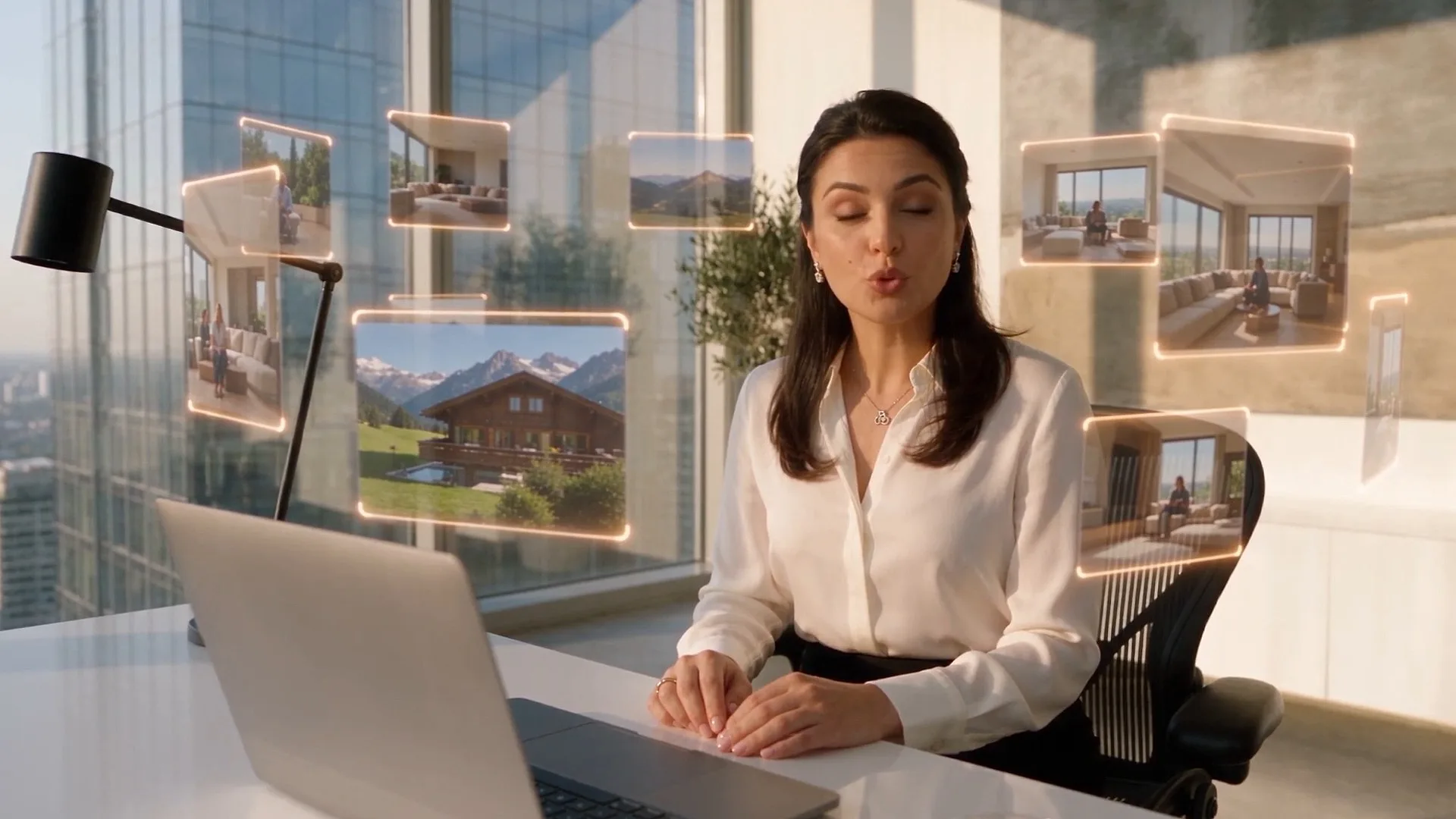
Watch three architectural renders become a chalet in winter, a private jet and a family villa. Two minutes, seven chapters and the full transcript.


See this on your own project
Send a brochure and two or three renders. We come back with a plan and a price.